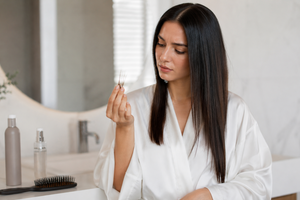
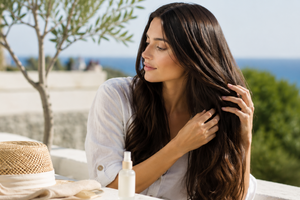
Many of our hair experiences significant stress—coloring, perms, straightening, and frequent styling. Hair loses its shine, becomes porous, dry, and brittle. In this situation, hair restoration, which focuses on gentle yet deep treatments, comes to the rescue. But can you do this procedure yourself using deep-restoring masks? Or is it better to seek professional help—at a salon? Let's take a closer look.
What is hair restoration?

It's important to understand that hair is a non-living part of the hair (the hair shaft) and cannot regenerate on its own, so qualified help is required. Deep hair restoration is a professional treatment that uses specialized products for deep strand reconstruction. It involves the absence of intense heat: the product is applied to clean strands and left on, often under a plastic cap, without the use of a straightening iron. Sometimes, gentle heat is used to enhance the effect of the products—a thermal cap or an ultrasonic straightening iron (which works without heat). This type of reconstruction involves the use of multi-component products, which may include amino acids, keratin, oils, hyaluronic acid, and lipids.
The goal of these procedures is to strengthen hair strands along their entire length, regenerate damaged areas, fill structural voids, enhance shine and smoothness, and restore elasticity. Hair reconstruction produces a visible lamination effect, making hair thicker, smoother, and less frizzy, giving it a more disciplined and well-groomed appearance. This procedure is suitable for hair that has suffered significant damage, such as restoration after coloring, perming, or straightening. It can also be used for damaged ends and loss of elasticity.
A type of hair restoration is reconstruction before keratin straightening. This is done using special bases that promote the restoration of damaged strands.
Salon Option: Advantages and Limitations
Many hair care salons offer hair restoration services. In the price list, it is most often listed as a cold restoration procedure or cold Botox. Among the advantages of in-salon treatments:
- In the salon, the technician conducts a diagnosis, selects a professional formula, and a personalized approach allows for deep reconstruction of the hair structure;
- Safety - the technician strictly monitors the process and is responsible for the result, which minimizes the likelihood of adverse reactions;
- Individualized post-procedure support - the technician evaluates the result and provides care recommendations based on the current condition of the hair and its needs.
At the same time, it should be noted that deep hair restoration in a salon requires time and money. And hair restoration by a professional technician does not replace comprehensive at-home care - after-treatment care is essential, otherwise the results quickly fade.
Home Remedies: Pros and Cons in the Context of Cold Treatments
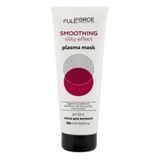
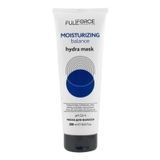
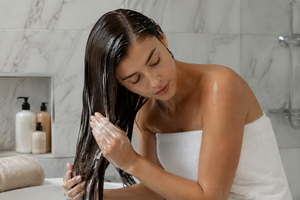
Deep hair restoration at home has its advantages. Firstly, it saves money and time. Secondly, if you purchase a set of intensive nourishing and regenerating products, they will last for many uses.
At the same time, it's important to remember that a full-fledged hair restoration procedure at home isn't as easy as it seems. Difficulties can arise in:
- Selecting products for the procedure - choosing deep hair restoration products on your own, tailored to your hair's specific needs and characteristics;
- Preparing the strands for the procedure, particularly using deep cleansing shampoos;
- Applying the product to the hair - it's important that it covers all strands, but not too much.
Without the right technique (for example, zoning, application, and fixation), it's difficult to achieve a salon-quality effect.
What to choose: salon treatment or at-home treatments?

If your hair is severely damaged - colored, heat-treated, brittle, or prone to split ends - it's advisable to start with a salon-quality cold treatment to achieve deep restoration. However, it's important to understand that to maintain the results, you'll need to continue at-home care with high-quality products.
If going to a salon isn't an option for you, you can certainly try restoring your locks yourself. However, for at-home treatments, choose only products from trusted, reputable brands. This way, you won't be disappointed with the results.
For moderately damaged hair, deep hair restoration at home can be a good starting point. However, if your goal is to restore deep strength, elasticity, and density, a combined approach of salon treatments and at-home maintenance is optimal.
How to properly organize your care?
To achieve ideal results and deep restoration Hair care should be comprehensive:
- First, a hair condition assessment is necessary (porosity, damage, condition of the ends and roots).
- Professional cold restoration salon treatment: the stylist selects a formula with an emphasis on keratin nourishment, deep hydration, and strengthening of the roots and lengths.
- After the treatment at home: use masks and products with amino acids, oils, moisturizing ingredients, leave-in treatments, and heat protection before styling to maintain the results.
- Maintenance: repeat salon treatments every 3-4 weeks (or as recommended by the stylist), and in between, use home care several times a week.
- Choose sulfate-free home care products with additional color-protecting ingredients for colored hair and innovative complexes to support hair regeneration.
A deep hair restoration treatment is a modern, gentle, yet effective option for those who want to restore strength, density, shine, and smoothness to their hair. If you approach this procedure wisely—using high-quality products and regular home maintenance—you can achieve lasting results even with severe damage. Specialized formulas help thicken the structure, provide moisture, eliminate frizz, and maintain the health and strength of your locks along their entire length.
You can purchase professional hair restoration products at the Keratin-Shop online store. Here you'll find a wide selection of high-quality products for hair regeneration, keratin straightening, Botox, and home care.